-Harry M. Benshoff’s, “The monster and the homosexual” is an article that talks about how homosexuals and monsters were at one point strongly connected to each other. This would go on to an individual, family, and community level. Homosexuality was seen as so monstrous that it was even tied into being compared to a pedophile or child killer. On top of that Benshoff goes on to talk about the definition of queer and how it’s used regarding the monster and the main characters. He goes on to speak about it on a larger scale once he begins to bring up how queer is used in sociological terms. Benshoff then goes on to talk about the type of audience of people that would go and see horror movies. Hoping that people would understand his work/writings so that maybe a queer spectator can go and enjoy a horror movie.-
Jack Sholder’s 1985 A Nightmare on Elm Street Part 2: Freddy’s Revenge was the second film in the Freddy Krueger series. This time the killer’s main target is Jesse, the son of a man who just bough the Elm Street house. Freddy takes advantage on this sexually confused boy and forces him to do his bidding and uses him to serve his twisted needs. A Nightmare on Elm Street Part 2: Freddy’s Revenge can best be analyzed utilizing Harry M. Benshoff’s, “The monster and the homosexual” because it allows viewers to have a better understanding that at one point in life, and amongst some still today, being a homosexual is monstrous and causes problems on the individual, family, and community level. Much like how monsters cause problems, this article helps getting the perspective of how homosexuals were viewed and how homosexuals felt about themselves.
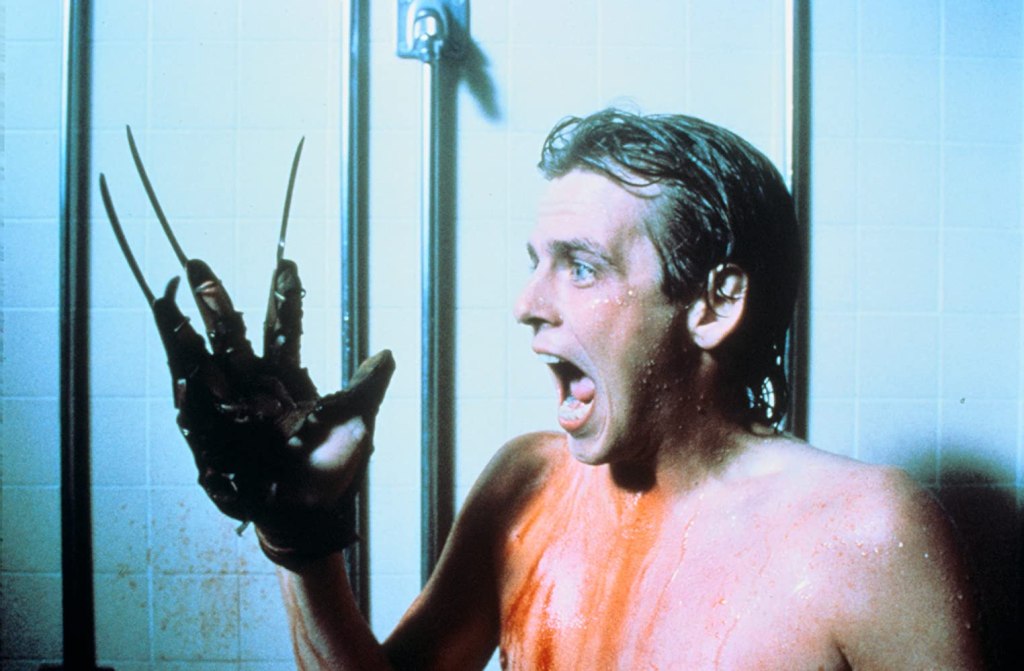
To start off, Benshoff states, “Homosexuality as a threat to others – homosexuals have been frequently linked in the media to child molestation, rape, and violence.” A Nightmare on Elm Street movies tells the story of a man who would kill children when he was alive. Once he was ultimately killed by the missing children’s parents, his rage allowed him to turn into some sort of dream demon that terrorizes teenagers. This is important to know because in the second film, the story opens with a frightening scene, a bus dropping off high school children suddenly goes crazy and drives out into the desert. The ground falls around it until it is in a see-saw-like position. The driver reveals himself as Freddy Krueger, who proceeds to go after the kids. Just before he strikes with his razor-blade glove, it cuts to a normal family having breakfast and we hear the main character, Jesse, waking up from a nightmare and screaming like a little girl.
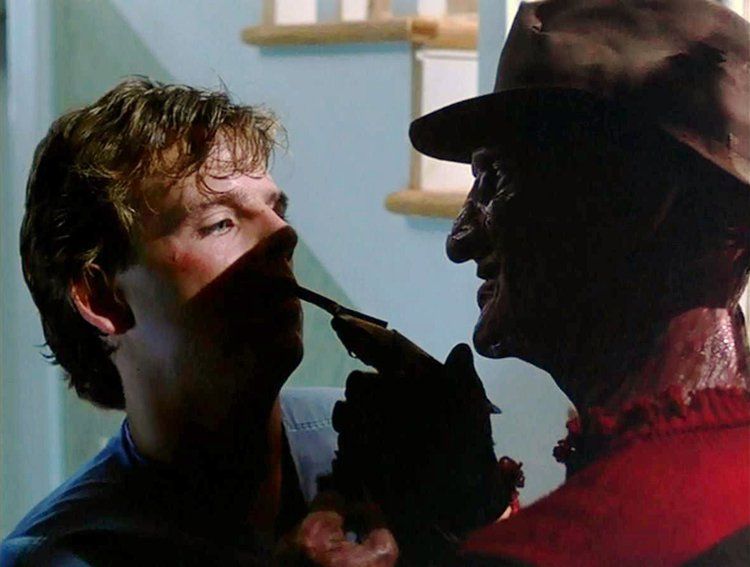
Additionally, Benshoff states, “Third and perhaps most important way that homosexuality enters the genre is through sub-textual or connotative avenues. For the better part of cinema’s history, homosexuality onscreen has been more or less allusive: it lurks around the edges of texts and characters rather than announcing itself forthrightly.” This can best be seen through the relationship between Freddy and Jesse. Clearly Freddy Krueger isn’t gay, but instead he does anything he needs to do to further progress and obtain what he wants, that being Jesse. Freddy knows of Jesse’s secret and that’s how Freddy get’s into him. Not in a gay way, but in an evil demon possession kind of way. Jesse is of course terrified of Freddy. He doesn’t want to sleep with him; he wants to get away from him (Figure 2). Freddy even goes on and says this to Jesse, “I need you, Jesse,” Freddy Krueger growls. “We’ve got special work to do here, you and me,” he says, tenderly flicking the hair out of the teenage boy’s eyes. “You’ve got the body. I’ve got the brain.” This clearly reflects the quote by Benshoff above.
Finally, Benshoff states, “By queer, I mean to use the word both in its everyday connotations (questionable, suspicious, strange, etc) and also as how it has been theorized in recent years within academia and social politics. This latter queer is not only what differs in some odd way from what is usual or normal, but ultimately is what opposes the binary definitions and proscription of a patriarchal hetero sexism. Queer can be a narrative moment, or a performance or stance which negates the oppressive barbarisms of the dominant hegemony. Queerness disrupts narrative equilibrium and sets in motion a questioning of the status quo.” This quote is important because A Nightmare on Elm Street Part 2: Freddy’s Revenge is a majorly gay/queer movie. Viewers see Jesse and how he is being tormented by this crazy dream demon. On top of that, by looking deeper, a comparison could be made that Freddy was the gay part inside Jesse that would come out violently if Jesse suppressed it. Using this same concept, viewers can understand the outcome of Jesse’s girlfriend who he ends up with, but Jesse’s inner gay was still there when it bursts out of the girls body.
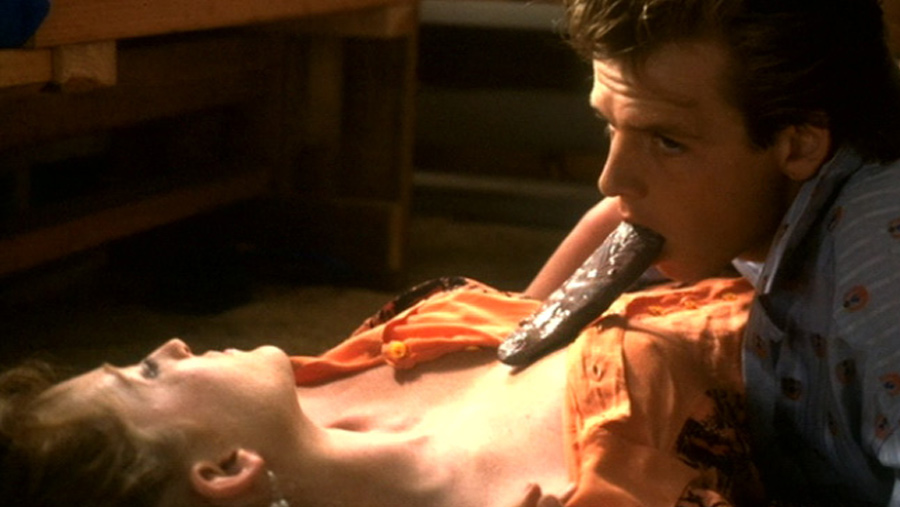
To further utilize the quote from above, no matter how many advances that Jesse would make on a girl, it would end tragically by how Jesse’s inner gay (Freddy), would act up and make it seem that what a normal heterosexual couple would be doing would be seen as monstrous and horrifying (Figure 3).
Al together, Jack Sholder’s 1985 A Nightmare on Elm Street Part 2: Freddy’s Revenge was created to be a subtly gay movie about the main character having problems embracing and accepting his sexuality. When the main character fails to embrace this, his inner gay is personified and manifests within his household as Freddy Kruger. The best way to get further clarification on this movie is to use Harry M. Benshoff’s, “The monster and the homosexual.”
 Film and Culture 20/SP*CMS*353*A (Conor Diggs)