-“Trying to Survive the Darker Side: 1980s Family Horror” by Tony Williams talks about how horror in the 1980s was developing and what direction it was going in. Horror at this time period was at a seeming relapse because a lot of horror films were copies of 70s slashers. However, Stepfather films began to arise and they were a reflection of what would happen to families that went against societal norms. With that being said, the 80s could be compared to the 50s, but in an extreme mild version. Tony Williams also uses work from Carol Clover to explain the direction of horror and all of the underlying meaning that these new horror films began to portray. What Williams states and explores through Clover’s work, as well as his own research, clearly shows and demonstrates the rise of Stepfather films and horror during the 1980s.-
*BLOG POST BELOW*
“Father knows best.” That’s a line many viewers can relate to while watching Joseph Reuben’s 1987 The Stepfather. The Stepfather is a chilling tale that follows Terry O’Quinn as Jerry Blake who has a knack for killing his family. O’Quinn’s character is first seen as he is washing away the blood from killing his family, he changes his appearance and leaves them and his past life behind. O’Quinn throws all of the objects of his past life into the ocean and disappears for over a year and eventually comes back to society as a real estate agent named Jerry Blake (Figure 1). The Stepfather can best be analyzed by utilizing Tony Williams, “Trying to Survive the Darker Side: 1980s Family Horror” because of how Williams describes that 1980s horrors illustrated Lenin’s thesis of “One step forward, two steps backward. Most of these 1980 films reprimanded those who questioned norms in the United States.
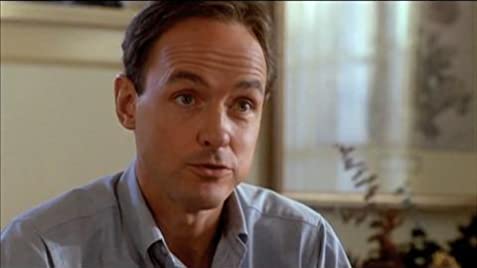
To start off, Williams states, “Appearing in an era pathologically affirming conservative family values, most 1980s horror films brutally chastied those disobeying ideological norms.” This can be seen in The Stepfather because Blake is initially seen as the perfect family man. Blake is all about the traditional working class, being married with children, traditional conservative lifestyle for that time period. That changes however when someone in his family angers him or is not perfect. That’s when Blake murders them all, changes his identity, and finds a new family.
Additionally, Williams states, “Not all 1980s horror films resemble the The Friday the 13th cycle. The decade also saw the appearance of the Stepfather films as well as related works such as Flowers in the Attic (1987) and Parents (1989) by no means supportive of the status quo. In fact, a meticulous examination of the period reveals a more contradictory, but never pleasant picture. But most 1980s cinematic narratives, horror or otherwise, attempted to maintain dominant values.” This is an important quote because it talks about the shift in which way horror movies were going. A lot of the movies being produced were copies of the more famous slasher flicks that came out earlier in that era, and it was good for the movie business that Stepfather films began to rise up. The best things about Stepfather films was the underlying meanings that came from them. The Stepfather at points had the viewers rooting for Blake because of how desperately he was looking for an ideal traditional family which he just couldn’t find. If Blake didn’t end up killing his “new” family members, this film could quickly turn into a drama instead of a horror/thriller.
Finally, Williams states from Carol Clover’s work, “Films articulate the anxieties of the 1980s generation experiencing the effects of massive gender confusion. Clover argues that most contemporary horror films reveal an obsession with feminism, displaying plots concluding with images of masculinized female power offering visual pleasure structured not according to sadistic male gaze, but around a more radical victim-identified point of view involving particular masochistic pleasures. Clover thus believes that masochism, rather than sadism, is the dominant feature in horror cinema.” This is an interesting quote because it goes against a lot of what happens in The Stepfather. Blake, as stated before, is a man obsessed with wanting an ideal family, Blake’s standards and values are old fashioned and all he wants to be is a good father and husband, yet if they let him down he becomes a homicidal maniac and wipes out his family (Figure 2).
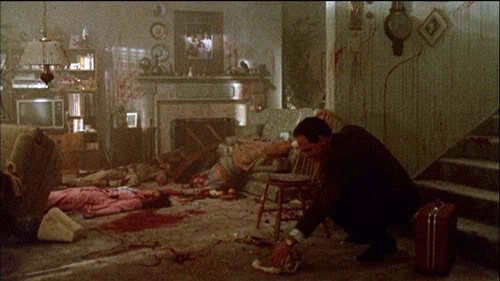
In The Stepfather, sadism is more prevalent at first glance, but after more analysis, it is evident that masochism is a larger driving force. Even though Blake kills a lot of the families he does not seem “perfect,” it is shown in the film that the pain which is inflicted upon him takes a mental toll based on all of the personalities he has to create in order to find that perfect family to take hold on. Williams does a great job explaining how Stepfather films does a good job providing underlying meaning to a genre of horror which could’ve been seen as a clone of basic slasher films.
Altogether, The Stepfather is a chilling film about a crazed man who is in pursuit of finding and locking down a perfect family that must meet all his standards. If they don’t, he turns into a murderer that kills them all and moves onto his next victims. This film can be analyzed by using Tony Williams, “”Trying to Survive the Darker Side: 1980s Family Horror” because the texts talk about the rise of Stepfather films, the direction of 1980s horror, as well as utilizing pieces from Carol Clovers work to further show how some of these films have greater underlying meanings compared to what they portray.
 Film and Culture 20/SP*CMS*353*A (Conor Diggs)