A majority of young high school teenage girls knows what it’s like to be in an apprehensive situation. These situations can be in a domestic household or somewhere non-domestic. Unfortunately, home and high school can be a place of physical or emotional abuse carried out by bullies or family members that create an environment of anxiety and dread. No other movie does a better job portraying this type of horror than Brian De Palma’s 1976 Carrie. This movie focuses on the distressing tale of a high school girl who is tormented in every aspect of her life and her catastrophic blood-curling coming of age. Carrie can be analyzed and understood utilizing Shelley Stamp Lindsey’s, “Horror, Femininity, And Carrie’s Monstrous Puberty,” by getting an understanding of how menstruation and puberty are shown and considered to be monstrous in society.

Lindsey states, “The film presents female sexuality as monstrous and constructs femininity as a subject position impossible to occupy. ” This is an important statement from Lindsey in her article because it lays out the foundation of why female sexuality is considered monstrous, as well as providing a statement which allows the audience to pick up on multiple scenes during the film which portrays female sexuality as heinous as they push into womanhood from their first menstrual cycle and struggle with their sexual identity. Carrie’s mother was sexually abused in the past, which leads Carrie’s mother to both reject femininity and transpose her fears onto Carrie. Carrie’s rites of passage is made to seem terrifying. On top of that, Carrie’s peers seek to reawaken the woman “within” her, while others seek to destroy “it”. At prom, the two ideals of repressed femininity and promiscuity collide with Carrie in the middle. In either case, Carrie has no control over her own sexual identity.
Additionally, Lindsey states, “Not only is Carrie a female monster, but sexual difference is integral to the horror she generates; monstrosity is expliciabily associated with menstruation and female sexuality.” This can be seen by viewers and the audience once Carrie awakens her telekinetic powers after her menstruation in the shower. Lindsey goes on and states, “In the shower scene, where victim and attacker converge on Carrie’s body, menstruation and castration are fused in a fantasy of sexual differences permitted by the generic confusion of horror, melodrama, and the supernatural.” None of Carrie’s peers help her out in a humane way, instead they ridicule her and shame her for a natural function of a woman’s body (Figure 2).

Furthermore, Lindsey states, “The shower scene parallel only hints at monstrous aspects of female sexuality which are soon made explicit, when, as a by-product of her first period, Carrie gains telekinetic powers. Hysterical and inconsolable in the shower room, she bursts an overhead light bulb through the sheer force of rage.” These , telekinetic abilities slowly sprout from Carrie’s turmoil and suffering. De Palma handles this element of the tale with extreme attention, by never allowing Carrie’s newfound power to become a simple gimmick. There are no scenes in the movie with Carrie practicing or honing her skills. The film instead allows her powers to emerge from moments of fierce human emotion. When Carrie panics, becomes sad, frustrated, or angry, light bulbs explode, windows and doors slam shut, mirrors fracture, and buildings burn (Figure 3).
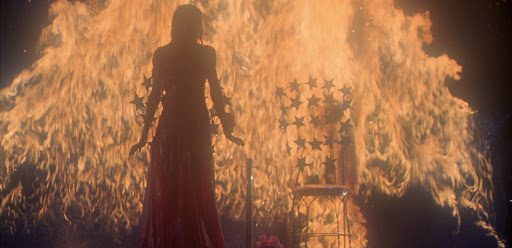
Altogether, Brian De Palma’s 1976 Carrie is a powerful story and adaption of what it’s like to be a teenage girl and showcases what it is like to be an outcast who harbors powerful emotions of anger, sadness, and frustration. Demonstrating that their is a monster within all individuals as well as highlighting the monstrosities of female sexuality, menstruation, and puberty.
 Film and Culture 20/SP*CMS*353*A (Conor Diggs)