What happens when a director decides to mix a slasher film with a murder mystery? Scream is what happens. Director Wes Craven produces a terrifying film which utilizes every stereotype of the slasher film and satires them. The opening scene is one of the most haunting images for teenagers and parents alike. Scream starts out innocent. A random prank caller out of the blue seemingly flirts with a teenage girl named Casey Becker. The caller asks for Becker’s name, when Becker asks why, the caller replies with one of the most petrifying lines ever uttered by a slasher villain, “I want to know who I’m looking at.” The terrible realization in Becker’s eyes are the same of what the audience shared.
Becker finds her boyfriend on her balcony tied to a chair, and is forced to play a game to save his life of horror trivia. When Becker gets the answer of who the killer in the first Friday the 13th movie wrong, her boyfriend is eviscerated, showing how serious the film actually is. Becker tries to run, but gets sliced into and has her vocal cords cut, unable to call for her parents in front of her who just arrived home. Becker is stabbed many times over, and is found by her parents flayed from a tree. Scream is another one of those films which can be analyzed using “Her Body, Himself,” by Carol Clover by understanding the role of males and females in slasher films and how it applies to slasher films in the late 20th century.
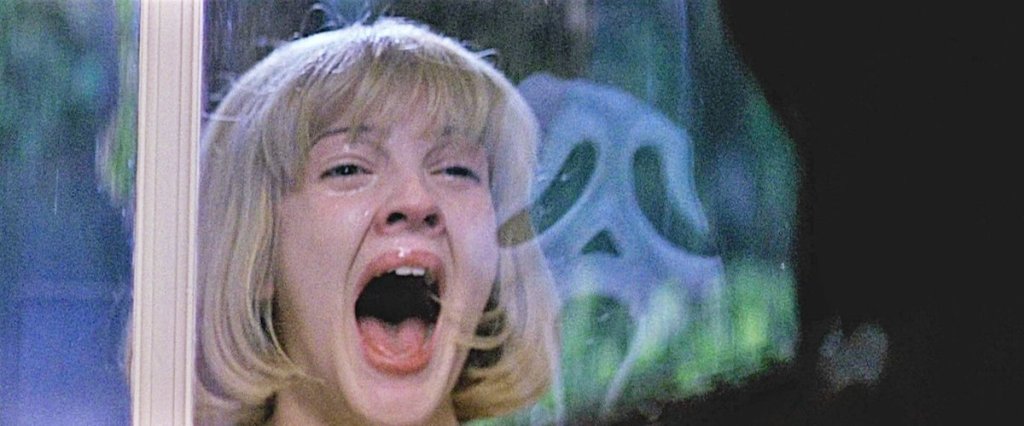
The plot of Scream is simple, but effective. A masked knife wielding murderer known as the “Ghostface” is stalking the students of Woodsboro High and killing them one by one. The killer is excessively obsessed with one girl, Sidney Prescott, who gets involved in the murders to unmask the killer. Everyone in the film is familiar with all of the traditional slasher film tropes. The main characters know that they shouldn’t walk alone at night. They know that having sex is an invitation to be murdered by the killer. They know not to say things to each other like, “I’ll be back.” All of the tropes that most early slasher film characters did not display.
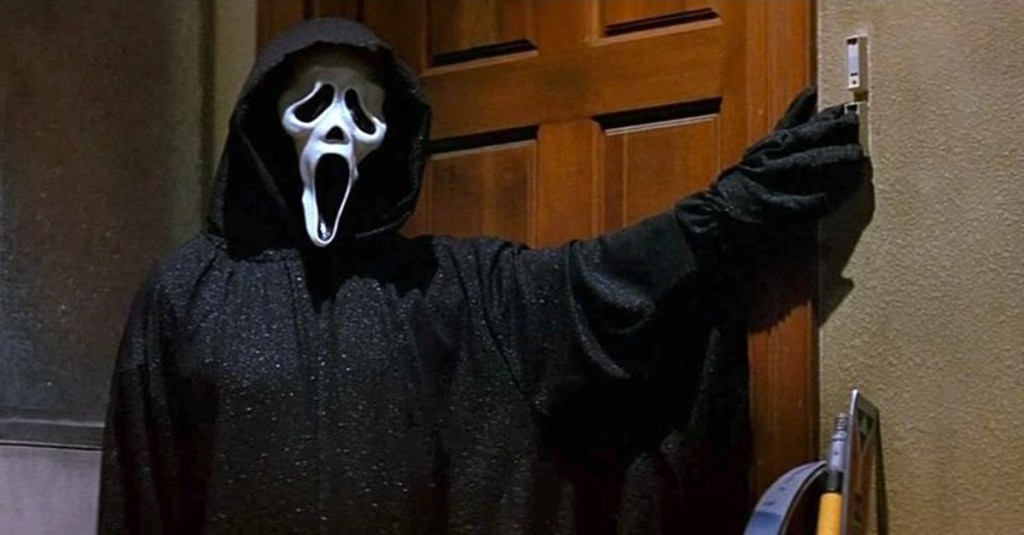
One of the most important aspects of Scream is how The Body is represented between the killers and their victims. This can best be understood when Clover states, “The killer is with few exceptions recognizably human and distinctly male; his fury is unmistakably sexual in both roots and expression; his victims are mostly women, often sexually free and always young and beautiful ones.” This is shown in Scream by how Billy killed Tatum as well as Sydney’s mother, Maureen. The reason why Billy goes on this killing spree is because Maureen Prescott has an affair with Billy’s dad, which leads to Billy’s mom abandoning them. This strikes fury into Billy and he goes on to rape and murder Maureen Prescott, as well as murdering Tatum as the “Ghostface” (Figure 2).
Additionally, Scream does a good job of breaking the rules of a slasher film, by not always abiding by slasher film code. Carol states, “In the slasher film, sexual transgressors of both sexes are scheduled for early destruction. The genre is studded with couples trying to find a place beyond purview of parents and employers where they can have sex, and immediately afterwards (or during) are killed.” At the start of the film, the two characters who were killed did not have anything sexual going on with each other. Sure, Becker was going to be home alone with her boyfriend, but based off of the timing, the two would have just been watching TV by the time Becker’s parents arrived. Yet, the Ghostface murdered these two based off of getting a horror movie question wrong. Anybody that had read Clover’s work, would be confused, but excited in the direction that Scream would be going in.
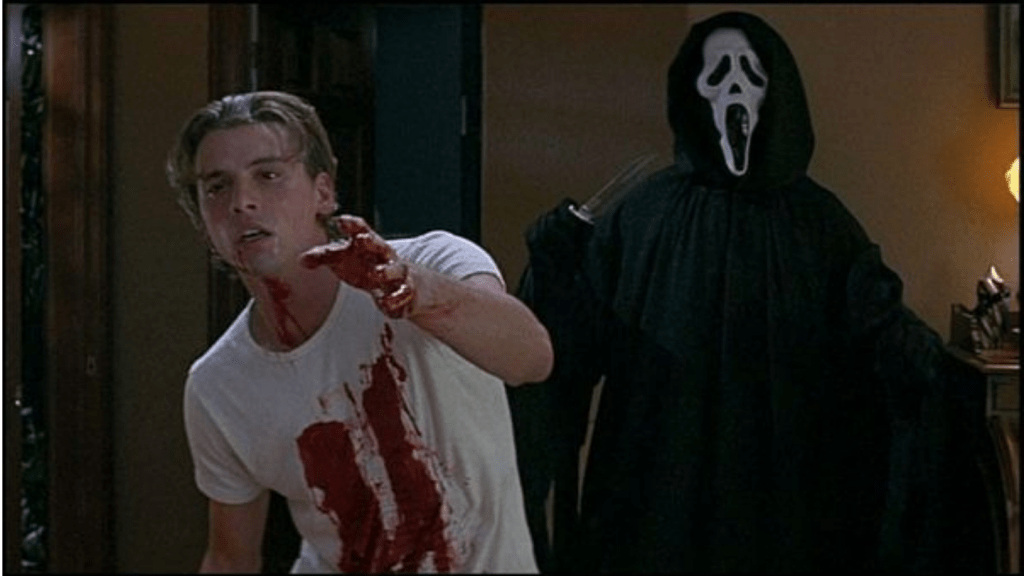
However, Scream once again does an excellent job in confusing the audience once sex occurs between Sydney Prescott and her boyfriend which follows up with the immediate “death” of her boyfriend Billy (Figure 3). Clover states that, “The death of a male is always swift; even if the victim grasps what is happening to him, he has no time to react
or register terror. He is dispatched and the camera moves on.” This is true in the light of Billy’s supposed death. The camera wastes no time to follow Sydney’s reaction and her interaction with the killer. Yet, once it is revealed that Billy wasn’t killed and was actually one of the main murderers, the slasher film trope is again thrown out the window.
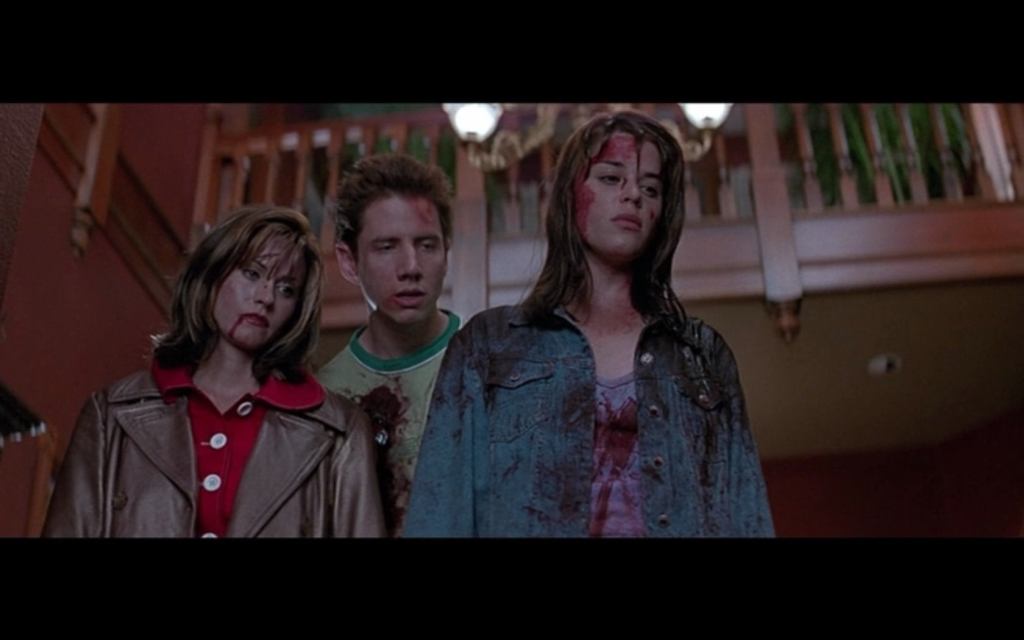
Finally, Clover states that, “The Final Girl is boyish, in a word. Just as the killer is not fully masculine, she is not fully feminine-not, in any case, feminine in the ways of her friends. Her smartness, gravity, competence in mechanical and other practical matters, and sexual reluctance set her apart from the other girls and ally her, ironically, with the very boys she fears or rejects, not to speak of the killer himself.” This is fascinating because in Scream, there isn’t a final girl despite everyone knowing it’s Sydney. Gale Riley is also left alive as with Sydney. The two females are both highly feminine and don’t show nearly as much as a tomboyish attitude as compared to Laurie Strode in Halloween. This once again shows that Scream went into great detail of making a mockery of what every slasher film was before the release of this masterpiece.
Altogether, Scream is a satire of slasher films which makes it an immediate classic. The film can be compared and contrasted using Carol Clover’s, “Her Body, Himself,” which allows readers and viewers to get a better understanding of the slasher genre, but also an idea of why this movie is considered great, due to it going against everything slasher tropes usually throw at the audience.
 Film and Culture 20/SP*CMS*353*A (Conor Diggs)