It’s a night of masquerade, of offering to the dead. It’s when autumn leaves dance across sidewalks, when children pose as ghost and ghouls in the hope of getting candy. Halloween is the night when evil spirits wreak havoc; when the veil between the worlds of the living and the dead is at its thinnest. “The Shape,” is a blur, somehow embodying both realities. The immortal 1978 classic Halloween tells the story of “The Shape,” an escaped mental patient known as Michael Myers, who returns to his hometown on Halloween night to stalk and kill a group of babysitters. John Carpenter, the director of Halloween, brought a terrifying era for scary movie watchers. Carpenter brought death and terror to movie watcher’s neighborhoods. Additionally, the plausibility of Halloween is far more realistic compared to other movies such as The Texas Chainsaw Massacre or The Exorcist. Chances of a sociopath breaking into a home is far greater than the Devil possessing a young girl, or a group of friends who foolishly choose to explore a suspicious house of murderers in the middle of no-where. Halloween can be analyzed and understood by utilizing Carol Clover’s, “Her Body; Himself,” by getting an idea of serial killer movies and how males and females are conveyed. Gender roles are clearly defined between genders in slasher films, with the killer predominantly being male and the victim is consistently the female character.
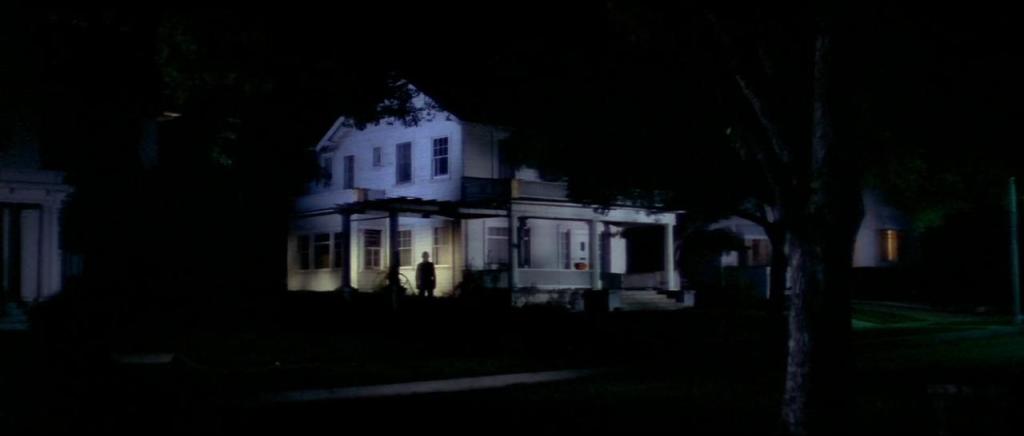
International Pictures)
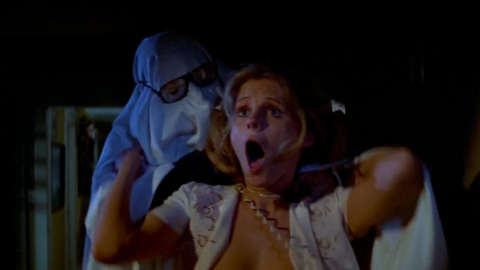
In “Her Body; Himself” by Clover, she includes some quotes from men in regards to female distress in the horror film. “They have said that beautiful women are preferable to watch die than men or ugly women, that the viewer will worry more for the safety of a female victim than a male victim (due to the patriarchal idea that women are weaker than men), that women are not tortured enough. What these men also say, through their films, is that they most prefer women when they are half naked, being killed by a “blatantly phallic murderer”, even making sounds reminiscent of orgasm as she dies” (Clover). This statement is true based off the multiple murders of women that Michael Myers commits throughout the film. More specifically, the statement by Clover can be seen when Michael murders Annie Brackett and Lynda Van Der Klok.

International Pictures)
While Annie is being strangled by Michael (Figure 2), she lets out multiple pants and grunts as she struggles to free herself. Michael as well can be heard breathing heavy, mimicking the sounds of two lovers on their wedding night. This scene in (Figure 2) further reinforces the idea of when Clover says that men prefer to watch beautiful women die than males or ugly females. This can also be seen in (Figure 3) when Michael murders Lynda Van Der Klok who is half nude when being strangled by a phone wire.
International Pictures)
Even though most of the women are murdered in Halloween the last survivor is a female. In almost all slasher horror’s, the final person is a female. This can be understood by using “Her Body; Himself.” Clover states, “However, despite this misogynistic slaughter of women, slasher films almost always end with the victory of the Final Girl” (Clover). Clover addresses the transsexuality of female spectatorship, going back to the idea that due to the phallocentric male gaze as described by Mulvey, in order to watch films, women are required to adopt an element of transsexuality in order to project her own ego onto the male protagonist, and homosexuality in order to project her desire onto the objectified female. The slasher film however, flips this, forcing men to project their ego onto a female protagonist. This idea is shown throughout Halloween once the audience begins rooting for the final girl, Laurie Strode (Figure 4).
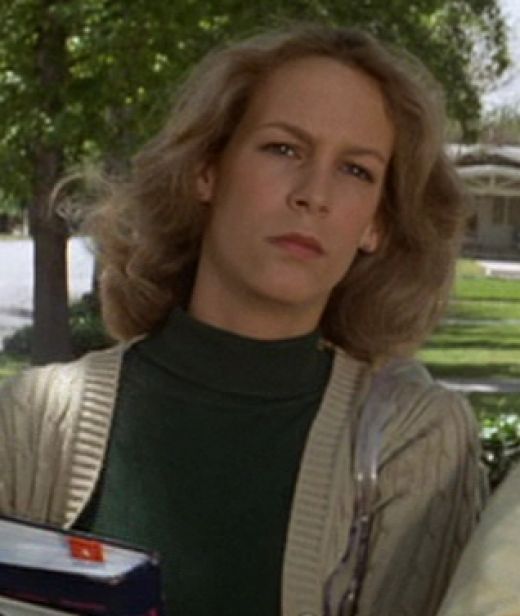
International Pictures)
Clover states,”the female character and usually protagonist who is introduced at the beginning, undergoes character development through the film, and is the only character to survive through the end. She is the first character to understand that something is amiss, the one who learns with us of the threat, through whom we see the remains of her murdered friends. She defeats the villain and becomes the hero, and we celebrate with her when she is safe” (Clover). Who the Final Girl is clearly defined early on in Halloween. Audience members can pick up on these hints that it was Laurie Strode because of how she recognizes the abnormal events that was happening to her in Haddonfield (Figure 5).
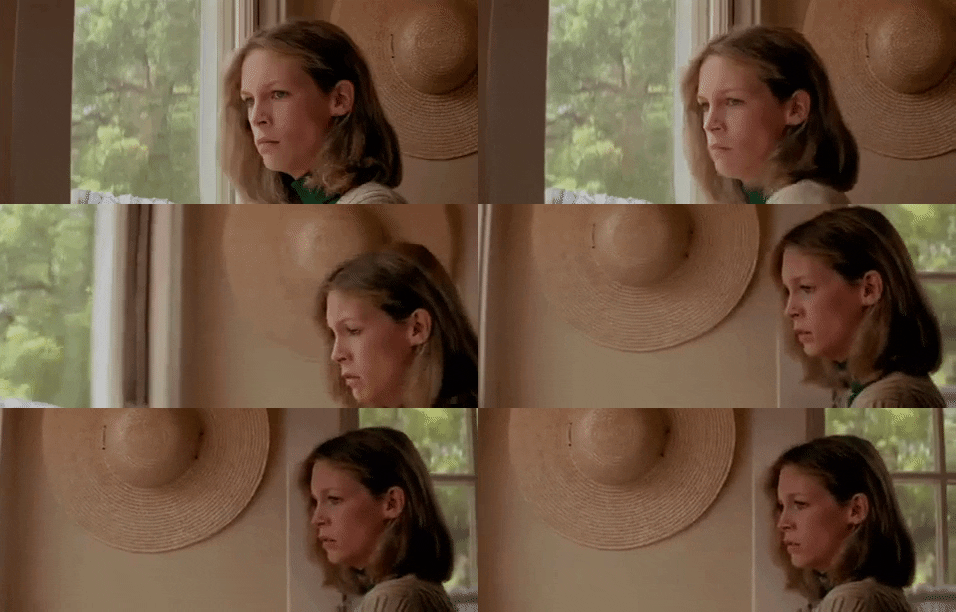
International Pictures)
Clover explains an important reason as to why the victim is female. She is to be stalked and hunted. Laurie is to scream, cry, and hide. Feeling terror, she’s androgynous enough for the male viewer, feeling the feminine terror but “not so feminine as to disturb the structures of male competence and sexuality.” By violating the body of the female character, onto which the viewer’s ego is projected, the film is allowed to violate the audience in a way in which would not be allowed for a man to be violated. Clover then concludes that the Final Girl is not a feminist character, as she is there for the use of the male spectator, as a “vehicle for his own sadomasochistic fantasies” (Figure 6).
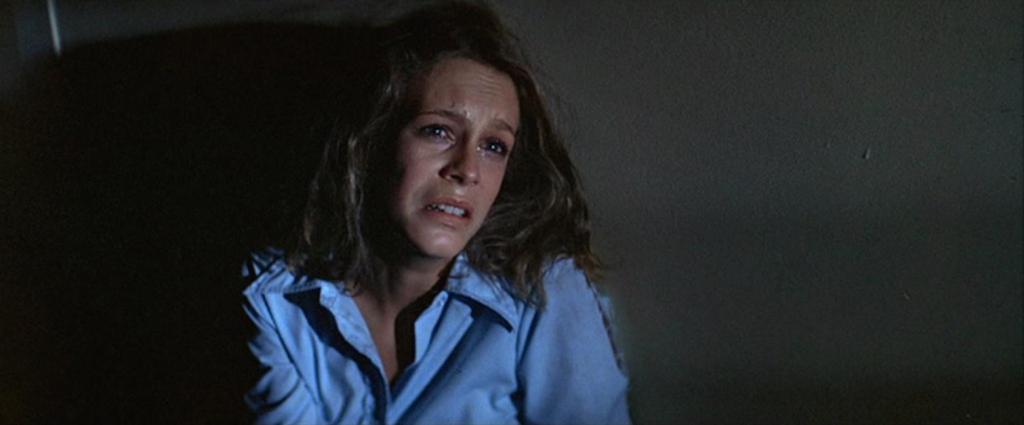
International Pictures)
All together, Halloween personifies everything that scares people. Blurry images of a killer standing in the background, shadows ominously gliding across a wall, dark rooms, creepy and haunting music. An overall sinister story of a mad man which can best be understood by “Her Body; Himself,” by Carol Clover.
 Film and Culture 20/SP*CMS*353*A (Conor Diggs)